A VNA test cable does not need to fail completely to create bad measurement data.
In many labs, the problem is more subtle: the calibration looks good, the connectors are clean, and the cable still passes a basic insertion loss check. But after the cable is moved, bent, routed differently or handled during daily testing, the measured result shifts enough to make the engineer question the setup.
That is where phase-stable RF cable assemblies matter. For VNA test systems, the cable assembly is not just a connection between the instrument and the device under test. It is part of the calibrated measurement path.
Engineer’s Selection Problem
If the cable is moved after calibration, does the measurement remain repeatable enough for the test? For VNA applications, the answer depends on phase stability, amplitude stability, connector durability, bend handling and how the cable assembly will be used every day.
Short answer: Use phase-stable RF cable assemblies when VNA measurement repeatability matters after cable movement, bending, handling or temperature change. Low insertion loss is important, but for many VNA setups, phase and amplitude repeatability after movement can be more important than the lowest possible loss number.
This article explains when VNA test systems need phase stable cable assemblies, how cable movement affects repeatability, and what engineers should specify when requesting a high-frequency RF cable assembly for test and measurement.
Why VNA Test Cables Need More Than Low Loss
Low insertion loss helps protect signal level. It is important for long cable paths, weak signals and systems with tight loss budgets. But a VNA test cable is often judged by a different question:
Does the measurement stay repeatable after the cable is handled?
In daily VNA use, cables are rarely left in a perfect static position. Engineers connect and disconnect devices, move fixtures, reposition adapters, open and close chambers, and route cables around instruments or test boards. Each movement can create small mechanical changes inside the cable assembly.
Those changes may show up as phase shift, amplitude variation, return loss change or measurement drift. In some test setups, the cable does not need to have very high loss to become the weak point. It only needs to change enough after calibration to affect the result.
For a broader comparison, see Low Loss RF Cable vs Phase Stable RF Cable: Which Matters More?
Where Phase Stability Becomes Important
Phase stability becomes important when the test result depends on repeatability, not only absolute signal transmission. This is common in S-parameter measurement, component characterization, calibration-sensitive setups and production test stations.
| VNA test condition | Why phase stability matters | Cable assembly concern |
|---|---|---|
| Cable movement after calibration | Movement can shift phase and amplitude response. | Cable construction, bend stability and strain relief. |
| Repeated connect / disconnect testing | Connector and cable handling may change the measurement path. | Connector durability, boot structure and operator handling. |
| Production test station | Small drift can create false pass/fail variation. | Repeatability, ruggedization and assembly consistency. |
| Temperature-sensitive measurement | Cable response may change with temperature. | Cable material, construction and environmental condition. |
Low Loss vs Phase Stable in a VNA Setup
For VNA test systems, low loss and phase stability are not the same requirement. A cable can be low-loss but not stable enough for repeated movement. A phase-stable test cable may not always have the lowest possible attenuation, but it is designed to reduce measurement change during handling.
| Requirement | Low-loss cable focus | Phase-stable test cable focus |
|---|---|---|
| Main problem solved | Reducing signal attenuation. | Reducing measurement change after movement or bending. |
| Typical use | Longer RF paths and signal-level-sensitive systems. | VNA, lab test, calibration-sensitive and repeatable measurement setups. |
| Key question | How much signal is lost? | How much does the result change after handling? |
| When it matters most | Loss budget and power transfer dominate. | Repeatability and calibration confidence dominate. |
In practice, many VNA test cables need both controlled loss and stable phase behavior. The final selection depends on frequency range, cable length, test movement, connector interface and how repeatable the measurement needs to be.
Typical VNA Cable Assembly Problems
When a VNA setup gives inconsistent results, the cable is not always the first suspect. Engineers may check calibration kits, adapters, fixtures and DUT connections first. But the test cable assembly should also be reviewed, especially when results change after the cable is moved.
Common cable-related problems include:
- Phase drift after the cable is bent or repositioned
- Amplitude variation after daily handling
- Return loss change after connector mating
- Uncontrolled bend radius near the connector boot
- Connector wear from frequent mating cycles
- Mechanical stress at the termination point
- Different results between replacement cables
The issue is often not one dramatic failure. It is small variation that becomes visible in a calibrated measurement system.
Connector Choice Still Matters
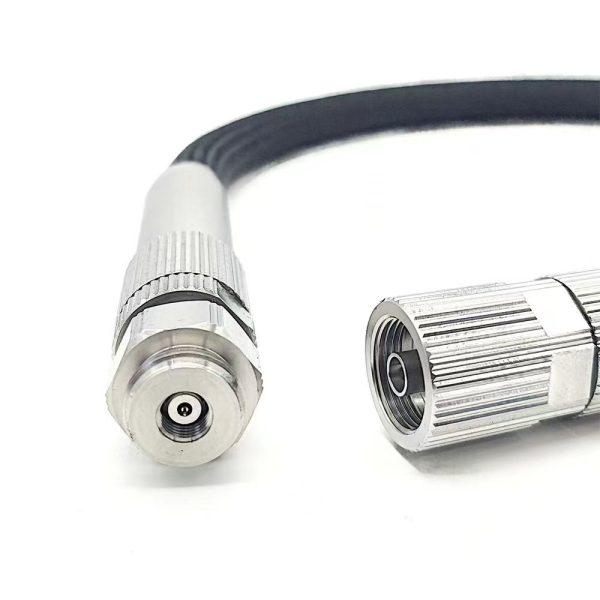
A phase-stable cable does not solve every measurement problem by itself. The connector interface and connector durability must also match the VNA port, adapter chain and device under test.
For high-frequency VNA test cables, common connector interfaces may include SMA, 3.5mm, 2.92mm, 2.4mm and 1.85mm depending on the measurement frequency and equipment interface. The connector pair should be selected based on both frequency range and actual mating condition.
Important connector details include:
- Connector interface and frequency range
- Gender and mating compatibility
- Port saver or adapter use
- Mating cycle requirement
- Straight or right-angle orientation
- Torque control and connector handling
- Strain relief near the connector termination
For connector interface selection, review Vinstronics precision RF connectors, including 2.92mm RF connectors, 2.4mm RF connectors and 1.85mm RF connectors.
When to Consider Ruggedized VNA Test Cables
Some VNA applications need more than phase stability. If the cable is handled daily, used by different operators, routed around fixtures or installed in a production station, mechanical protection becomes part of the performance requirement.
A ruggedized or armored VNA test cable may be useful when:
- The cable is moved frequently after calibration.
- Operators repeatedly connect and disconnect devices.
- The test station has tight routing or repeated cable stress.
- The cable is shared across multiple setups.
- Downtime caused by cable damage is expensive.
- Production testing requires stable results over many cycles.
For product-level options, see Vinstronics VNA ruggedized test cable assembly.
What to Specify Before Requesting a VNA Test Cable
A useful VNA test cable request should describe the measurement setup, not only the connector type and length. The more accurately the use condition is described, the easier it is to select the correct cable structure.
| Information to provide | Why it matters |
|---|---|
| Frequency range | Determines connector interface and cable performance margin. |
| VNA port interface and DUT interface | Defines connector pair, gender and adapter chain risk. |
| Cable length | Affects insertion loss, handling and routing. |
| Static or frequently moved setup | Helps decide between standard, phase-stable or ruggedized structure. |
| Bend radius and routing space | Prevents mechanical stress and unstable measurement behavior. |
| Required test data | Clarifies whether VSWR, insertion loss, return loss or phase stability data is needed. |
For a broader RFQ checklist, see Custom RF Cable Assemblies: What Engineers Need to Specify. For cable and connector co-selection, see Custom RF Cable Assemblies: Why Cable and Connector Selection Must Be Reviewed Together.
How Vinstronics Reviews VNA Test Cable Requirements
Vinstronics reviews VNA cable assembly requirements based on measurement frequency, connector interface, cable length, phase stability requirement, movement condition, bend radius, connector durability and required RF test data.
For a bench setup where the cable is rarely moved, a lower-loss flexible assembly may be enough. For calibration-sensitive work, daily lab testing or production stations, a phase-stable or ruggedized VNA test cable may be a better choice.
The goal is not to choose the most expensive cable. The goal is to choose the cable assembly that keeps the measurement path repeatable enough for the actual test condition.
FAQ
What is a phase-stable RF cable assembly?
A phase-stable RF cable assembly is designed to reduce phase and amplitude change caused by cable movement, bending, handling or environmental change. It is often used in VNA and repeatable measurement applications.
Why does cable movement affect VNA measurements?
Moving or bending a cable can change the electrical length and internal geometry of the cable assembly. In calibrated VNA measurements, those changes can affect phase, amplitude and return loss results.
Is low loss more important than phase stability for VNA cables?
It depends on the test. Low loss protects signal level, while phase stability protects repeatability after cable movement. Many VNA test systems need a balance of both.
When should I choose a ruggedized VNA test cable?
Choose a ruggedized VNA test cable when the cable is handled frequently, used in production testing, moved after calibration or exposed to repeated bending and operator handling.
What should I provide when requesting a phase-stable VNA cable?
Provide frequency range, connector pair, cable length, VNA port interface, DUT interface, movement condition, bend radius, routing space and required RF test data.
Need help selecting a phase-stable VNA test cable?
Send your frequency range, connector pair, VNA port interface, cable length, movement condition and test data requirement. Vinstronics can review whether a low-loss, phase-stable or ruggedized RF cable assembly is more suitable.