
Cryogenic Cables & Assemblies
Bridging the gap from 300 K to 10 mK
Low thermal conductivity RF interconnects for dilution refrigerators. Available as raw bulk coaxial cable or custom-terminated cable assemblies in NbTi, CuNi, and Stainless Steel (SS) configurations.
Fast quote inputs: raw/assembly • material • diameter • length/qty • interfaces (if assembled) • stage map.
The engineering challenge: RF loss vs. heat load
Cryogenic coax selection is a trade-space. Electrical conductivity, thermal conductivity, and routing constraints must align with your stage map.
Thermal management
From 300 K down to 4 K, limiting heat conduction is critical. SS and CuNi act as thermal brakes to preserve cooling power at higher stages.
Insertion loss control
Below 4 K, signal integrity becomes dominant. NbTi enters a superconducting state below ~9 K, enabling low-loss routing toward the mixing chamber.
Routing & flexibility
Geometry dictates bend limits and anchoring. Common ODs (e.g., 0.047" / 0.085") balance density, stiffness, and repeatability across stage transitions.
Sourcing options
Choose your supply path first—raw cable for in-house harness building, or turnkey cable assemblies for fast installation and verification.

Raw cryogenic cable
- •Supplied by meter/spool for in-house termination and routing.
- •Select OD and construction to match density and bend limits.
- •Material stacks tuned to stage mapping (SS/CuNi thermal brake; NbTi cold routing).
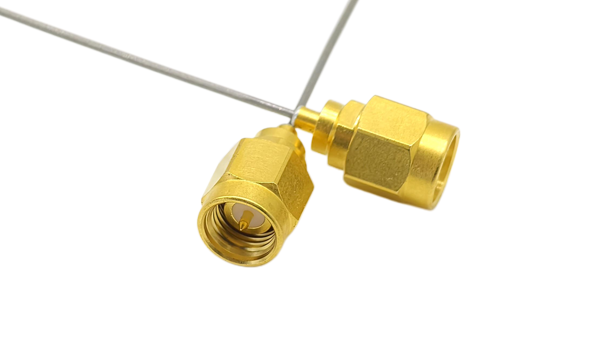
Cryogenic cable assemblies
- •Fully terminated, swept, and tested assemblies ready for installation.
- •Interfaces for dense cryostat wiring (SMA / SMP / SSMP), plus higher-band options as required.
- •Phase-matching available for multi-channel quantum architectures.
Stage selection guide + form factor planning
Start from your stage map. Select material to intercept heat at defined anchors, then choose a form factor that fits density, bends, and serviceability.
How to specify your build
Provide your stage anchors (300 K / 50 K / 4 K / still / mixing chamber), target band, and channel count. We’ll map material + diameter to thermal budget and RF attenuation targets.
-
1Choose format: raw cable or terminated assembly.
-
2Pick material: SS/CuNi for thermal brake; NbTi for low-loss cold routing.
-
3Confirm geometry: diameter, bend limits, and anchoring points.
Stage-to-material snapshot
* Final placement dictates heat load and total system noise budget.
Form factor capabilities
Discuss routing limits →Semi-rigid
Predictable routing and stable thermal anchoring at defined stages.
Flexible pigtails
Service loops, motion tolerance, and tight bends for dense layouts.
Phase-matched sets
Electrical length control for multi-channel pulse delivery and readout.
Feedthrough-ready
Integration across vacuum boundaries, bulkheads, and cryostat interfaces.
Technical FAQ
What is the difference between NbTi, CuNi, and Stainless Steel cryogenic cables?
Stainless Steel (SS) and Cupronickel (CuNi) offer high thermal resistance to minimize heat leaks from 300K to 4K stages, but have higher RF loss. Niobium-Titanium (NbTi) becomes superconducting below ~9K, offering near-zero RF insertion loss with very low thermal conductivity, ideal for 4K to mK stages.
Do you sell raw bulk cable or fully terminated assemblies?
We supply both. You can order raw cryogenic coaxial cable by the meter for custom in-house routing, or specify fully terminated, swept, and tested cable assemblies with SMA, SMP, or SSMP connectors.
Can you provide phase-matched cryogenic cable assemblies?
Yes. For multi-channel quantum control and qubit readout, we offer phase-matched sets of cryogenic cable assemblies to ensure tight timing alignment across your stage wiring.
How do I select the right cable diameter and bend radius?
Cable diameter affects both flexibility and heat load. Thinner cables (e.g., 0.047 inch) offer tighter bend radii for dense mK stages, while thicker cables (e.g., 0.085 inch) provide lower RF attenuation for longer runs. Minimum bend radii depend on the outer conductor material and construction.
What info is needed for a fast cable or cable assembly quote?
Please provide raw vs assembly, material type (NbTi/CuNi/SS), outer diameter, length, connector interfaces (if assembled), phase-matching requirements (if any), and quantity/lead time. A stage map accelerates alignment.
Ready to wire your dilution refrigerator?
Submit your stage map, material preferences, and lengths. Our engineering team will verify the thermal and RF configuration for your system.