Not every RF cable assembly needs full S-parameter data. But some applications should not be ordered based only on connector type, cable length and a typical datasheet value.
For a general internal interconnect, typical performance data may be enough. For a high-frequency test path, VNA setup, production test fixture, calibrated measurement path or matching-sensitive system, engineers may need assembly-level test data before the cable can be approved.
The key question is not simply “Can you provide a test report?” The better question is: what kind of RF cable assembly test data is actually needed for this application?
Typical Customer Question
“We need a 40 GHz RF cable assembly. Can you provide test data?” This question is useful, but incomplete. The RFQ should also define which parameters are required, the sweep range, report format, whether every assembly must be tested, and whether a Touchstone file is needed.
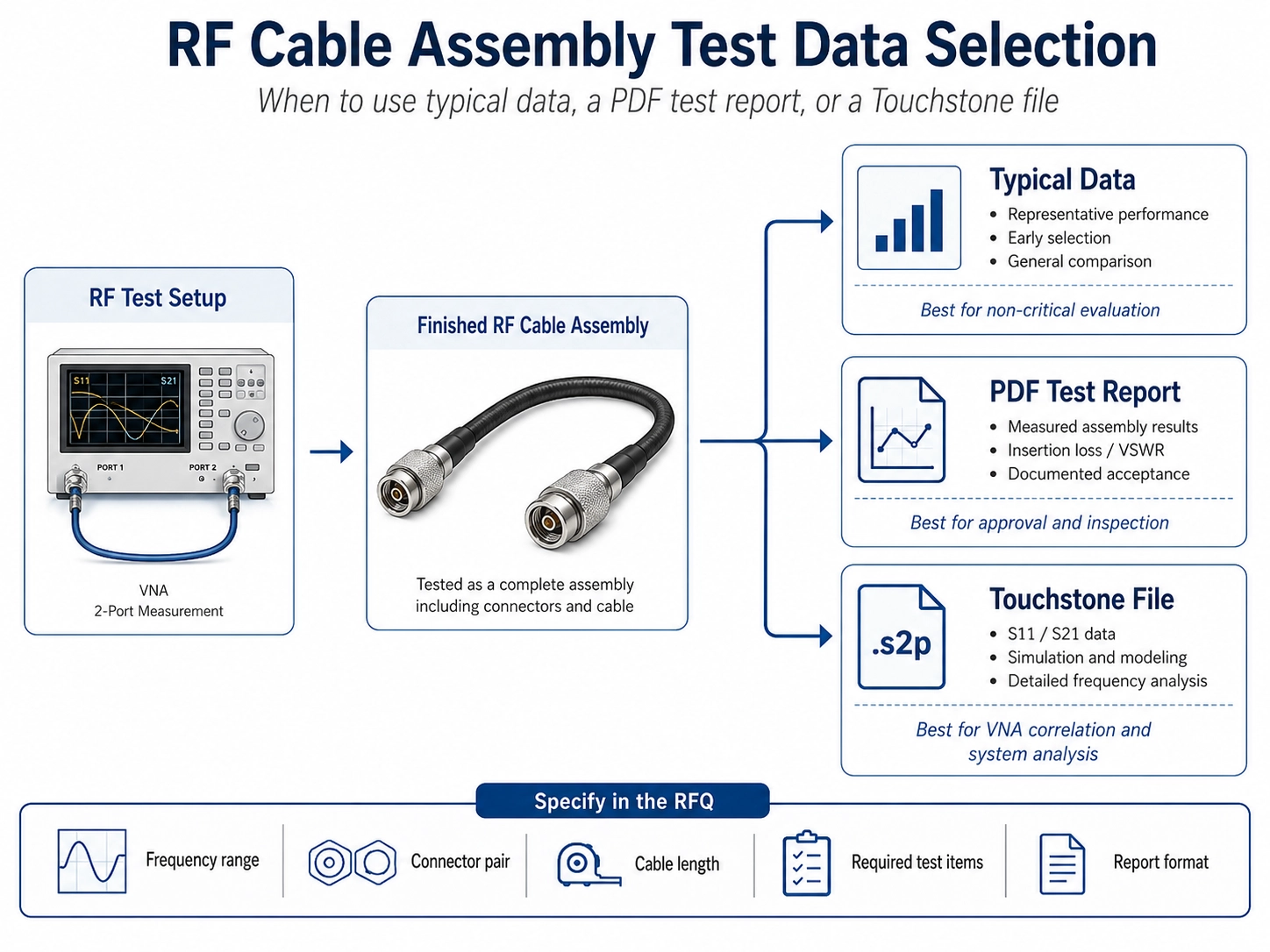
Quick decision: Use typical data for general evaluation. Request assembly-level PDF reports when the finished cable must meet defined limits. Request S-parameter or Touchstone files when the cable will be used in modeling, VNA correlation, cascaded path analysis or a measurement-sensitive system.
Typical Data Is Not the Same as Assembly-Level Test Data
Typical cable data is usually based on a cable family, a reference length or representative samples. It helps engineers compare cable options during early selection. But a finished RF cable assembly includes more than the bulk cable.
The finished assembly also includes the connector interface, cable-to-connector transition, termination process, cable length, routing condition and mating environment. These factors can affect measured insertion loss, return loss and VSWR.
This does not mean every assembly must be individually tested. It means engineers should match the test data requirement to the risk level of the application.
| Data type | What it usually means | Best fit |
|---|---|---|
| Typical data | Representative performance from a cable family or similar assembly. | Early selection, general comparison, non-critical interconnects. |
| PDF test report | Measured results for a finished cable assembly or production batch. | Engineering approval, incoming inspection, defined performance limits. |
| S-parameter / Touchstone file | Frequency-domain data such as S11 and S21 for simulation, modeling or detailed analysis. | System modeling, VNA correlation, cascaded analysis, high-frequency validation. |
What S11 and S21 Tell Engineers
S-parameters are useful because they describe how the RF path behaves across frequency. For most RF cable assembly discussions, the two most commonly reviewed items are S21 and S11.
- S21 is related to transmission through the cable assembly. Engineers use it to review insertion loss and frequency response.
- S11 is related to reflection at the input side. Engineers use it to review return loss, VSWR and impedance matching behavior.
For many procurement cases, engineers do not need a deep S-parameter theory discussion. They need to know whether the finished cable assembly has acceptable transmission and matching behavior over the actual operating frequency range.
For parameter-specific background, see RF Cable Assembly Insertion Loss: What Engineers Should Check Before Ordering and RF Cable Assembly Return Loss and VSWR: What Engineers Should Check.
When a PDF Test Report Is Usually Enough
A PDF test report is often the practical choice when the customer needs documented assembly-level performance, but does not need to import raw data into simulation software or analysis tools.
A PDF report may be suitable when:
- the project requires incoming inspection records;
- the customer needs measured insertion loss and VSWR curves;
- the cable assembly has a defined pass / fail limit;
- the data is used for quality documentation rather than modeling;
- the assembly is used in a lab, system integration or production environment where traceable results are helpful.
When requesting a PDF report, define the frequency sweep range, connector interface, required parameters and whether the report should be provided for each assembly or only for sample units. For a broader selection framework, see the RF Cable Assemblies Guide.
When Engineers Should Request Touchstone Files
A Touchstone file is more useful when the customer needs data that can be imported into RF simulation, system analysis or measurement correlation workflows.
Consider requesting Touchstone data when:
- the cable assembly is part of a high-frequency model or link budget;
- the engineering team needs to cascade cable assembly data with other RF components;
- the assembly is used in a VNA test path or measurement-sensitive setup, such as repeatable VNA measurements;
- the customer wants to compare measured data with simulation results;
- the system needs detailed S11 / S21 behavior over a frequency sweep.
Touchstone files are valuable, but they should be requested with clear scope. Otherwise, the supplier may not know the required frequency range, port reference, connector setup, file format or whether the data is needed per piece.
Should Every RF Cable Assembly Be Individually Tested?
Per-piece testing can be valuable, but it is not always necessary. It can also affect cost, lead time and quotation scope. The right decision depends on the application risk and documentation requirement.
Individual assembly testing is more appropriate when:
- the assembly is used near the upper end of its frequency range;
- the customer has a defined insertion loss, return loss or VSWR limit;
- the cable is used in a calibrated or repeatable measurement path;
- the assembly is part of a production test system;
- the project requires traceable acceptance data for each unit;
- the quantity is small but engineering risk is high.
Sample testing or typical data may be more practical when the assembly is used for a general-purpose internal interconnect, moderate-frequency system connection or early design evaluation.
What to Specify in the RFQ
Asking for “test data” is not enough. The RFQ should define what data is needed and how it should be delivered.
Useful information includes:
- operating frequency range and requested test sweep range;
- connector type, gender and mating interface at both ends; for interface planning, see cable and connector selection for custom RF cable assemblies;
- cable length and tolerance requirement; see how cable length affects RF cable assembly performance for related planning logic;
- required parameters: insertion loss, return loss, VSWR, S11, S21 or full S-parameters;
- target limits, if defined;
- report format: PDF report, data table, screenshot or Touchstone file;
- whether every assembly needs testing or only samples;
- required file naming, serial number or traceability format;
- routing, bend radius or handling conditions if performance after installation matters; see RF cable assembly bend radius and routing for related installation considerations;
- quantity, delivery schedule and whether the order is for prototype or production.
For a broader quotation checklist, see Custom RF Cable Assemblies: What Engineers Need to Specify.
Common Mistakes to Avoid
- Requesting “S-parameters” without specifying the frequency sweep range.
- Asking for a test report but not defining which parameters should be included.
- Assuming cable datasheet values represent the finished cable assembly.
- Requesting per-piece test data but expecting a standard non-tested quotation scope.
- Comparing test data from different setups without checking connector interface, calibration method or sweep conditions.
- Waiting until after production to define acceptance limits.
These issues are avoidable if the test data requirement is defined before quotation.
Practical Takeaway
RF cable assembly test data should match the engineering risk of the application. Typical data is useful for selection. PDF reports are useful for documented acceptance. S-parameter and Touchstone files are useful for modeling, correlation and detailed high-frequency analysis.
Before ordering, define the required test items, frequency range, report format and whether each assembly must be tested. This helps the supplier quote correctly and helps the engineering team receive data that is actually useful.
FAQ
Do all RF cable assemblies need S-parameters?
No. General-purpose interconnects may not need full S-parameter data. High-frequency, matching-sensitive, calibrated or production test paths are more likely to benefit from S-parameter data.
What is the difference between a PDF test report and a Touchstone file?
A PDF test report is usually used for documentation and acceptance review. A Touchstone file contains frequency-domain data that can be imported into RF simulation or analysis tools.
Which S-parameters are most important for RF cable assemblies?
S21 is commonly used to review insertion loss and transmission behavior. S11 is commonly used to review return loss, VSWR and reflection behavior.
Should test data be provided for every cable assembly?
It depends on the application. Per-piece testing is more useful for high-frequency, critical, calibrated or production test paths. For lower-risk applications, typical or sample data may be sufficient.
Need RF cable assembly test data for your project?
Send your frequency range, connector pair, cable length, required test items, report format and whether each assembly needs testing. Vinstronics can help review whether a PDF report, S-parameter data or Touchstone file is appropriate before quotation.